IFP-Run uPhongolo Municipality Faces Cashflow Crisis After High Legal and Operational Spending
The IFP-run uPhongolo Local Municipality in northern KwaZulu-Natal is facing serious financial pressure after heavy spending on legal costs and operational services.
An internal memo circulated to municipal officials confirms that the municipality is experiencing cashflow problems and has introduced emergency spending controls.
Several expenses, including travel, accommodation, hiring of new staff, and some procurement, have now been suspended while the municipality tries to stabilize its finances.
uPhongolo Municipality Cashflow Crisis Explained
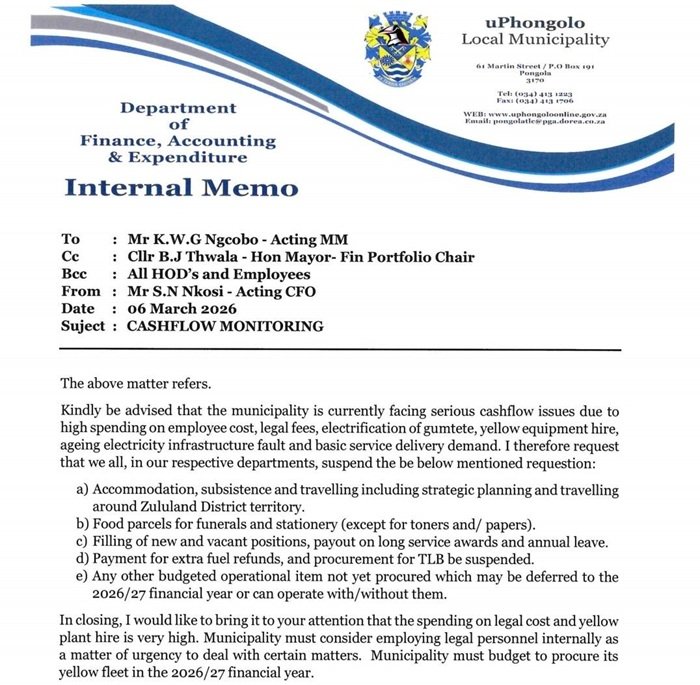
The financial situation came to light through an internal memorandum dated 6 March 2026 from Acting Chief Financial Officer S.N. Nkosi. The document, addressed to Acting Municipal Manager K.W.G. Ngcobo and shared with department heads and employees, outlines urgent measures to control spending.
According to the memo, the municipality is dealing with “serious cashflow issues” caused by rising employee costs, legal fees, infrastructure maintenance, and operational demands.
Officials were instructed to immediately suspend or delay several types of expenditure across departments.
Among the spending cuts listed in the memo are accommodation, subsistence, and travel costs for municipal activities, including strategic planning sessions and travel within the Zululand District. The memo also states that filling vacant posts and paying out certain employee benefits must be postponed.
These measures suggest the municipality is attempting to reduce outgoing payments while it addresses its financial position.
Legal Costs and Equipment Hire Raise Concerns
The memo highlights two major cost pressures: legal expenses and the hiring of heavy machinery, often referred to as “yellow plant” equipment.
Acting CFO Nkosi wrote that spending on legal costs and equipment hire is “very high,” suggesting that these areas are contributing significantly to the municipality’s financial strain.
In response, the finance department has recommended that the municipality consider hiring its own internal legal personnel to handle certain matters rather than relying on external legal services.
The memo also proposes that the municipality budget to purchase its own fleet of heavy machinery in the 2026/27 financial year. Officials believe this could reduce the long-term costs of hiring equipment for infrastructure work and service delivery projects.
Budget Cuts Affect Travel, Hiring, and Operational Spending
The memo lists several immediate cost-control measures that departments must follow.
Travel-related expenses, including accommodation, subsistence allowances, and travel within the Zululand District, have been suspended. The municipality has also halted the filling of new and vacant positions until further notice.
Other spending restrictions include the suspension of food parcels for funerals, stationery purchases except for essential printing materials, and extra fuel refunds.
The document further states that any operational spending that can be postponed should be deferred to the next financial year.
Municipal departments have also been advised to operate with fewer resources where possible while the financial situation is being monitored.
Service Delivery Pressures in Northern KwaZulu-Natal
The memo notes that the municipality is also under pressure from infrastructure challenges and service delivery demands.
Among the issues mentioned are ageing electricity infrastructure, faults, and the electrification project in Gumtete. These projects, along with other operational needs, have added to the financial strain on the municipality.
Local municipalities across South Africa often face similar challenges when balancing infrastructure maintenance, staff costs, and community service delivery needs within limited budgets.
When financial pressure increases, municipalities sometimes introduce temporary spending controls to stabilize their cash flow while longer-term solutions are considered.
What Happens Next for uPhongolo Local Municipality
For now, the internal memo indicates that municipal officials are focusing on monitoring spending and limiting new financial commitments.
The finance department has also suggested structural changes to help reduce future costs, including building internal capacity for legal matters and investing in municipal equipment rather than relying on hired machinery.
It remains unclear how long the spending restrictions will remain in place or whether additional financial measures will be introduced.
Residents and local stakeholders will likely be watching closely to see how the municipality manages its finances while continuing to meet service delivery expectations.
Financial stability in local government is closely linked to service delivery, infrastructure maintenance and employment opportunities within municipalities.
As discussions continue inside the municipality, the key question will be how officials balance cost control with the needs of the communities they serve.
- Kokstad Missing Child Case: 7-Year-Old Girl Still Missing as Homes Burn After Court Releases Suspect

Missing Man at Sea: Family Seeks Answers After Xolani Zuke Disappears at Mthwalume Beach